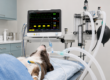











In the world of veterinary medicine, we often talk about the “gold standard.” We strive for it in our diagnostics, our surgical techniques, and certainly in our patient monitoring. For years, adding capnography to your surgical suite was the ultimate “level up.” Moving from just watching a pulse oximeter to monitoring EtCO2 monitoring data was a massive leap forward for patient safety. It gave us a window into the patient’s ventilation that we simply didn’t have before.
But as technology evolves and our understanding of anesthesia deepens, we have to ask ourselves: is a window enough, or do we need the whole view?
At Bionet America, we believe that providing the best care means never settling for “good enough.” While capnography is an essential tool, it does not necessarily tell the whole story. Relying on it alone during general anesthesia can leave a significant blind spot in patient monitoring and anesthesia management. To truly safeguard your patients, it’s time to talk about the transition to full multi-gas analysis. Built for Modern Veterinary Medicine, that means giving your team a more complete picture of your patient’s respiratory status and anesthetic management throughout every procedure. Bionet America: Smarter Solutions. Smarter Care. Better Outcomes.
The Capnography Baseline: Why We Started Here
Let’s give credit where it’s due. Capnography changed the game. By measuring the concentration of carbon dioxide in exhaled gases, the EtCO2 monitoring system acts as an early warning system. It tells us if the patient is breathing, how well they are ventilating, and provides a crude but effective look at cardiac output.
If the CO2 drops to zero, you know immediately that there is a problem: whether it’s inappropriate esophageal intubation, a disconnected circuit, or a cardiac arrest. It is the “smoke detector” of the operating room.
However, a smoke detector only tells you there’s a fire; it doesn’t tell you why the stove was left on or how hot the flames are getting. This is where the limitations of “just” EtCO2 become apparent.

The Blind Spot: What EtCO2 Can’t Tell You
Research has shown us that EtCO2 monitoring alone isn’t a perfect science. In many clinical scenarios, the numbers on the screen don’t perfectly correlate with the actual arterial CO2 levels in the blood. For instance, in patients with underlying respiratory disease, the correlation between EtCO2 and PaCO2 can be surprisingly poor.
Furthermore, factors like oxygen supplementation (something we do for every surgical patient) can actually distort EtCO2 readings, leading to values that appear lower than they actually are. When you add in technical hurdles like endotracheal tube leaks or small tidal volumes in our tiny feline or toy-breed patients, the “standard” of capnography starts to look a bit shaky.
But the biggest blind spot isn’t just about the CO2: it’s about the anesthesia gases themselves. Capnography tells you that the patient is breathing, but it doesn’t provide visibility into the anesthetic agents that are influencing both anesthetic depth and respiratory status.
Enter the Anesthetic Gas Analyzer: The Complete Picture
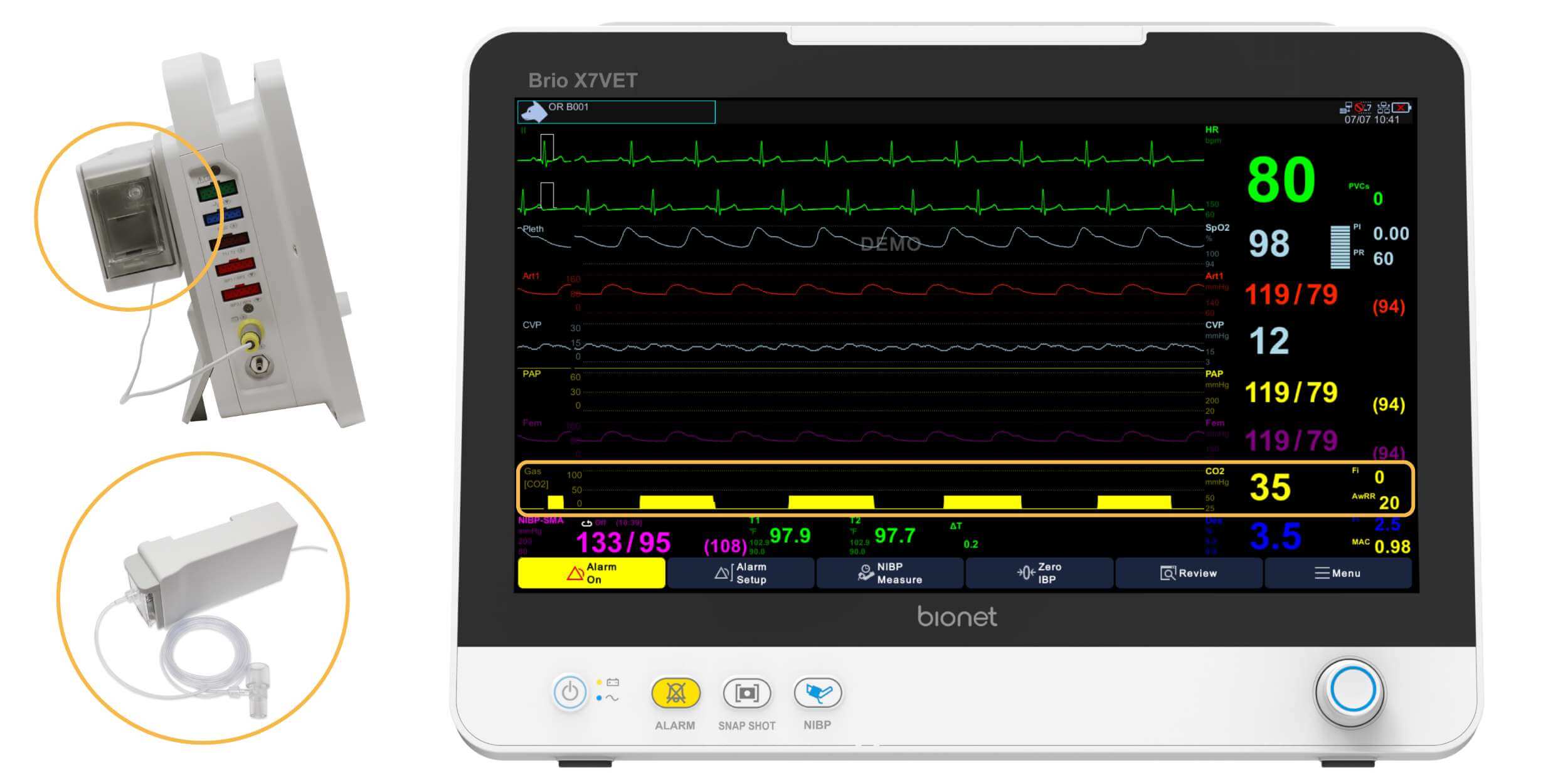
This is where the transition to dual gas and agent monitoring becomes a necessity for the modern high-standard clinic. By incorporating a full anesthetic gas analyzer, you aren’t just watching the waste product (CO2); you are measuring the medication you are delivering (Isoflurane, Sevoflurane, etc.).
A dual gas module monitors both the inspired and expired concentrations of your anesthetic agent. This provides three critical pillars of data that EtCO2 alone cannot provide:
1. Verification of Delivery
Have you ever had a patient start to wake up on the table, only to realize the vaporizer was empty? Or perhaps a dial was bumped – or for reasons that were not immediately apparent? An anesthetic gas analyzer gives you real-time confirmation of exactly how much agent is entering the patient’s system. It removes the guesswork and ensures that your equipment is performing exactly as intended.
2. Measuring Anesthesia Depth via MAC
This is the real game-changer. By measuring the End-Tidal concentration of the anesthetic agent, we can estimate the Minimum Alveolar Concentration (MAC). This is the most accurate way to determine if a patient is appropriately anesthetized.
- Too Deep: You can see if you are delivering far more agent than necessary, allowing you to turn down the vaporizer, save on drug costs, and: more importantly: prevent the hypotension and respiratory depression associated with deep anesthesia.
- Too Light: You can catch a “light” patient before they start paddling or vocalizing, allowing for a smoother, stress-free surgical plane.
3. Faster Recovery Times
Precision in delivery leads to precision in recovery. When you know exactly how much agent is in the patient’s lungs, you can time your “turn-off” perfectly. This leads to faster wake-ups, more efficient turnover in the OR, and happier clients who aren’t picking up a groggy, disoriented pet at the end of the day – all while supporting a safer recovery.
Our Framework for Your Success
At Bionet America, we don’t just sell monitors; we partner with veterinary professionals to improve outcomes. Our approach to technology is Built for Modern Veterinary Medicine and structured around a three-part framework designed to help your practice thrive:
- Smarter Solutions: We deliver advanced monitoring technology and dual gas capabilities designed for the real-world demands of veterinary anesthesia, including reliability in small patients.
- Smarter Care: We provide the training and support your team needs to move beyond basic monitoring and make confident, data-driven decisions for every patient.
- Better Outcomes: We help your clinic raise its standard of care with scalable technology that supports safer anesthesia, stronger workflows, and measurable clinical value.
Bionet America: Smarter Solutions. Smarter Care. Better Outcomes.
Why Veterinarians are Upgrading Now
The shift toward full gas analysis is being driven by a desire for better medicine and better risk management across the veterinary market. When we use EtCO2 monitoring alongside an agent analyzer, we are practicing “Total Patient Awareness.”
Think about your high-risk veterinary patients: the seniors with heart murmurs, the brachycephalic, or the emergency bloat cases. These patients have a very narrow margin for error. In these cases, “Just EtCO2” is gambling. Full gas monitoring allows you to titrate anesthesia to the exact needs of that specific patient, minimizing the physiological impact of the drugs while ensuring a painless procedure.
Making the Switch: It’s Easier Than You Think
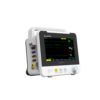
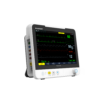
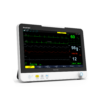
Many veterinary practitioners worry that upgrading to a full anesthetic gas analyzer means a steep learning curve or a complete overhaul of their systems. At Bionet, we’ve made the integration seamless. Our modules are designed to be “plug-and-play,” providing a clear, intuitive interface that your technicians will love. Where applicable, the Brio X7Vet serves as the featured monitoring platform for clinics ready to bring advanced gas analysis and high-visibility patient data into one veterinary-focused workflow.
By upgrading, you aren’t just adding a feature; you are adding a layer of professional security. You can show your clients the data-driven approach you take to their pet’s safety, which builds immense trust and justifies the value of your surgical services.
Built for Modern Veterinary Medicine, we deliver accessible, high-end technology so you can lead your community in veterinary excellence!
Final Thoughts: The Bionet Commitment
Monitoring is more than just numbers on a screen; it’s a promise of safety we make to every pet that walks through our doors. While EtCO2 was a great start, the move to dual gas monitoring is the natural progression for any clinic that prides itself on exceptional care.
Don’t let “good enough” be the ceiling for your practice. Level up to the precision, safety, and peace of mind that comes with a full anesthetic gas analyzer and a veterinary-focused monitoring strategy built around solutions like the Brio X7Vet.
If you’re ready to see how this technology can transform your OR, we are here to help. Explore our resources or request purchase information to take the next step in your journey toward the gold standard.
Contact us if you have any further questions! We are here to support you, your team, and your patients every step of the way. Because at the end of the day, we don’t just build monitors; we build confidence.
Built for Modern Veterinary Medicine. Bionet America: Smarter Solutions. Smarter Care. Better Outcomes.